
SaaS platform · 2025
HUUMO
AI-powered vendor automation — the intelligence layer that chases unacknowledged purchase orders so procurement teams don't have to. It ingests POs, follows up on a schedule until a vendor answers, escalates what needs a person, and puts a number on what the silence is costing.
Overview
Modern ERPs manage purchasing but stop short of managing vendor behaviour. They record that a purchase order was sent; they have nothing to say about whether anyone at the other end read it. That gap — between PO sent and PO acknowledged — is where silence turns into late surprises, and it is usually handled in inboxes and spreadsheets by whoever remembers to check.
An intelligence layer between planning and execution rather than another place to type things. It ingests purchase orders, runs rule-based follow-ups until a vendor responds, escalates what genuinely needs a human, and quantifies the financial cost of orders still unconfirmed.
Role
Full-stack — Next.js portal + NestJS API
Timeline
2025 · shipped
Stack
What needs a person today
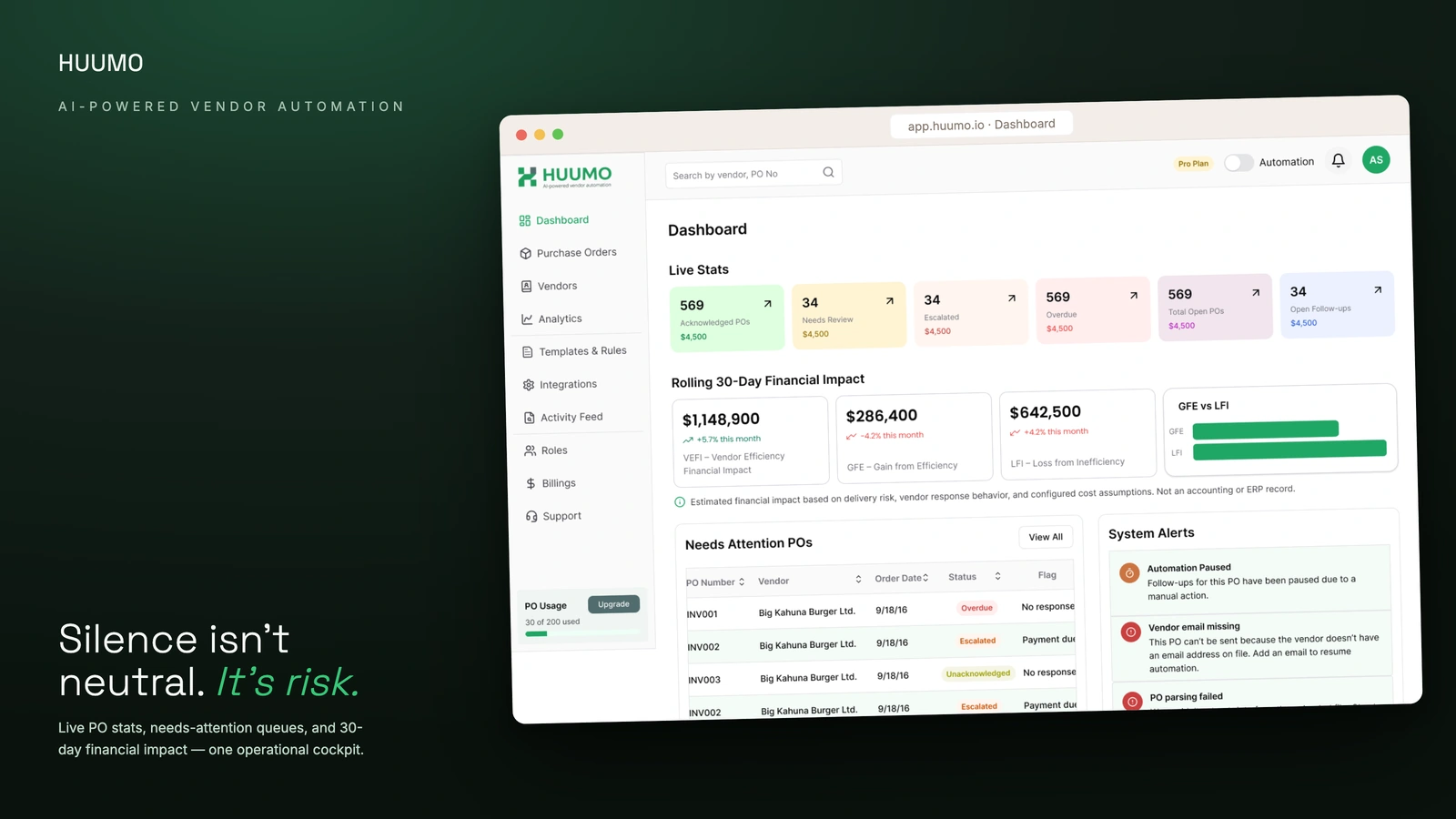
The dashboard above answers one question on open: what is not moving. Live counts split acknowledged from overdue, escalated and unacknowledged; the needs-attention queue lists the orders themselves; and system alerts surface the failures that quietly break automation — a vendor with no email address on file, a purchase order that would not parse. Those are the ones worth catching early, because an automation that has silently stopped looks exactly like one with nothing to do.
Chasing, until someone answers
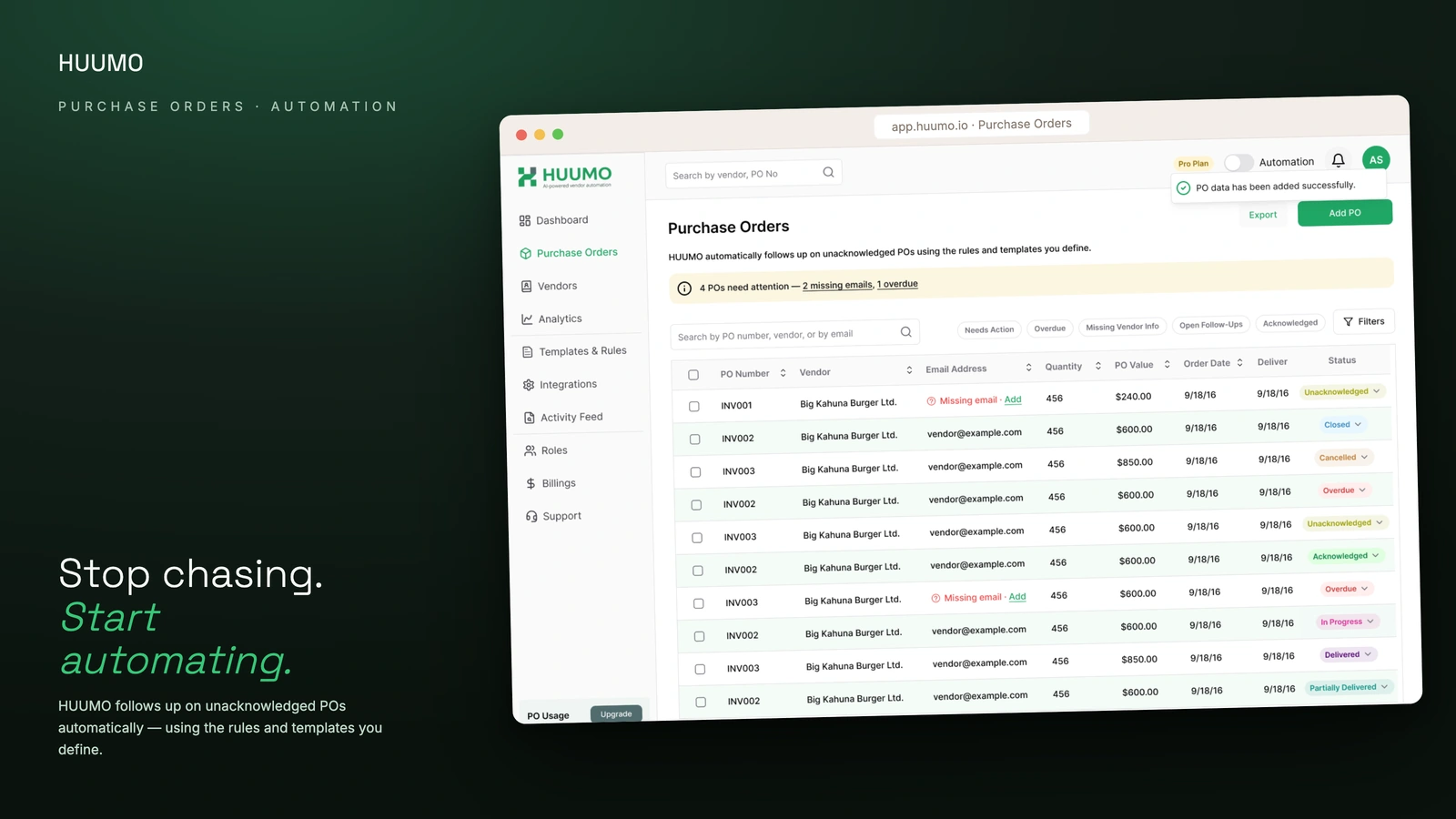
Every purchase order carries its own state: sent, acknowledged, overdue, escalated. Follow-ups run on configurable rules and templates rather than a fixed schedule buried in code, so the team decides how insistent to be and how long to wait. Messages go out through the team's own mailbox over Google or Outlook, which matters more than it sounds — a vendor answers a person they recognise far more readily than a no-reply address.
Putting a number on the silence
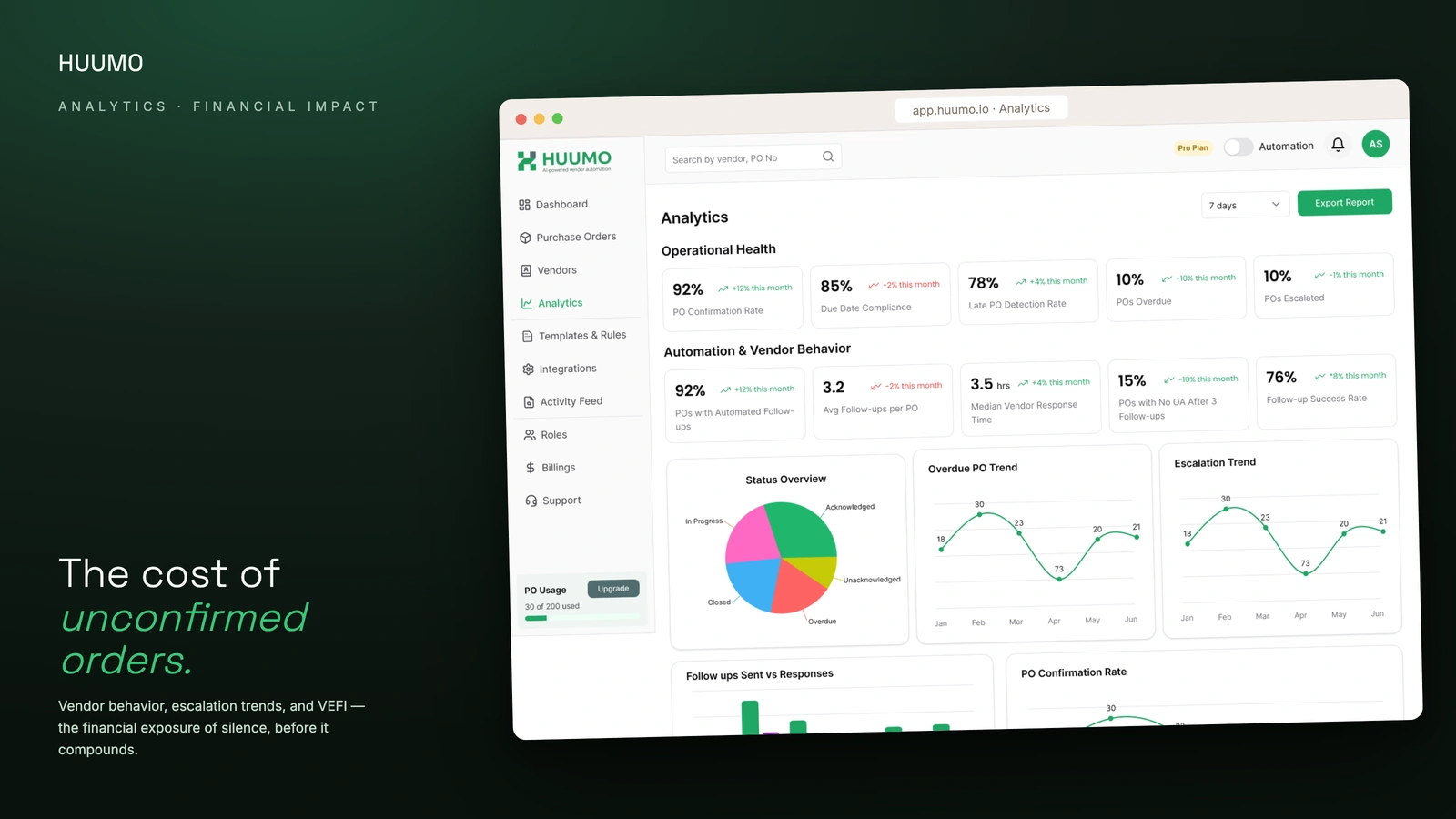
Operational dashboards tend to stop at counts, which makes them easy for leadership to ignore. VEFI — vendor efficiency financial impact — nets the gain from vendors responding promptly against the loss from those who do not, so the cost of chasing becomes a figure rather than a complaint. Each vendor carries a risk level derived from its own behaviour, which turns the question from “who is late” into “who is reliably late, and what does that cost us”.
Signing in with the mailbox that sends the mail
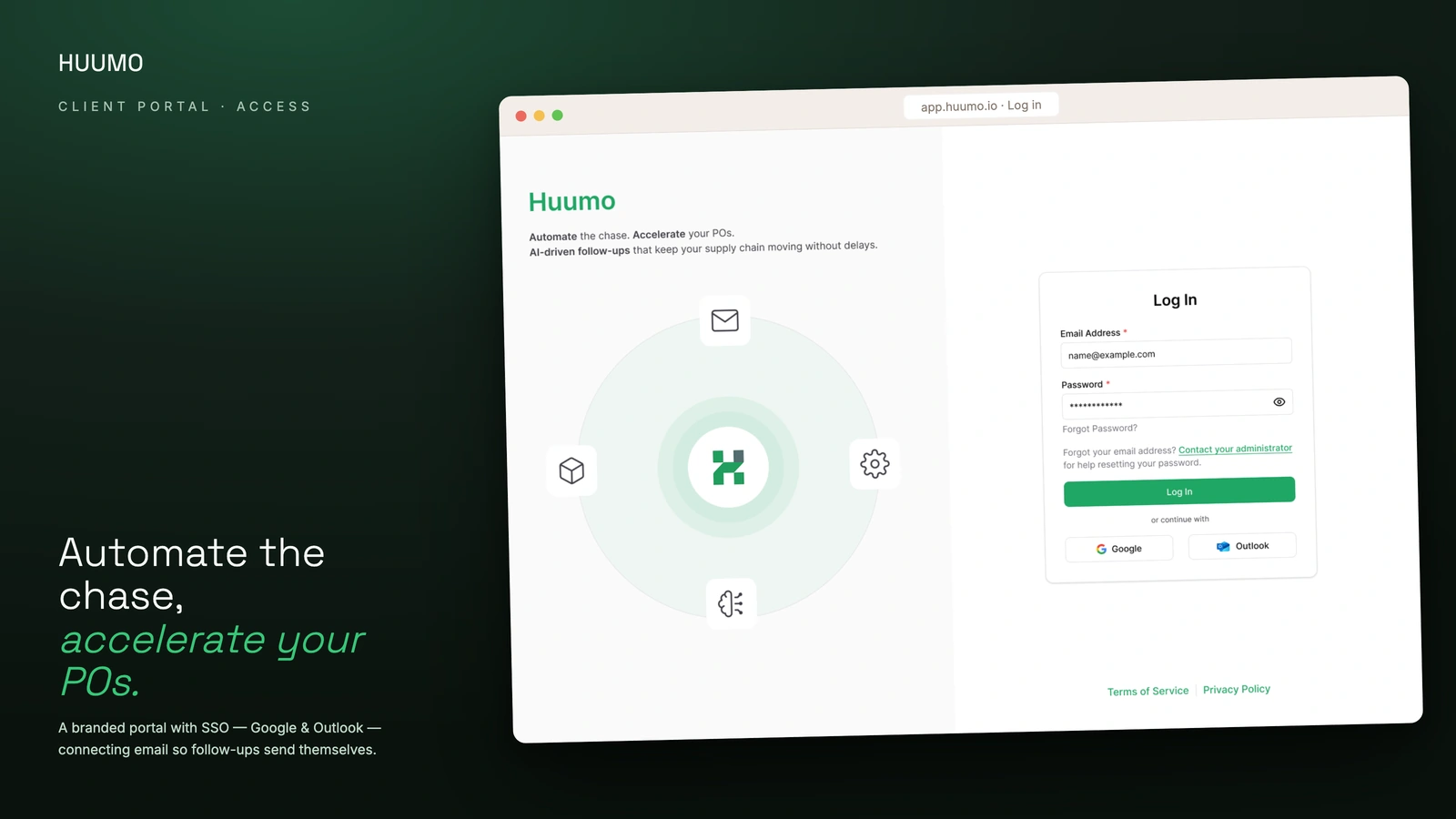
Sign-in is Google or Outlook SSO, which is the same account the follow-ups are sent from — so connecting the mailbox is part of signing in rather than a separate integration step someone has to be talked through later.
The challenge
What made it hard
Silence has no shape. An unacknowledged order does not raise an error or appear in a report; it simply sits there looking identical to an order that is fine, until the delivery date passes and it is too late to act.
Chasing is the kind of work that gets dropped first. It is repetitive, easy to defer, and invisible when it is being done well — which is exactly the profile of work that should not depend on a person remembering.
Procurement, planning and leadership each need a different view of the same problem: what to chase today, what is at risk this month, and what the whole pattern is costing. Three audiences, one set of facts.
Approach
How it was built
Silence is modelled as a first-class risk signal. An order nobody has acknowledged is not an absence of data — it is the data, and the product treats it as a state worth alerting on, scoring and pricing.
Follow-ups are sent from the team's own inbox through Google or Outlook SSO and email integration, so a vendor receives a message from the person they already deal with rather than from an unfamiliar automation address.
Rules and templates are configurable rather than hardcoded, so the cadence of chasing is a setting the procurement team owns instead of a change request.
Built as a Next.js portal and landing site over a NestJS API. Claude Code carried the plumbing; the product decisions — treating silence as risk, making the follow-up rules configurable, and defining the financial metric — were deliberate.
Outcome
What shipped
Automated, rule-based follow-ups that keep chasing until a vendor answers, sent from the team's own inbox.
Needs-attention queues, escalations and system alerts — including the failures that quietly break automation, like a missing vendor email or a PO that would not parse.
Analytics covering operational health and VEFI, the vendor efficiency financial impact, with a risk level per vendor.
One shared source of truth across procurement, operations and leadership, in a single product with its landing site.
Want something like this?
Tell me what you're building and I'll tell you honestly how I'd approach it. Replies within hours.
Prefer email? Write to me directly at — it reaches the same inbox.